Source check
Ratings, screenshots, version and install tier are treated as public store signals, not as a LogicAppGuide endorsement.
Curated brain-training & logic apps for Android







Charlemagne Medieval Strategy is covered in the LogicAppGuide Android app library as a Strategy app. Use this page to compare fit, screenshots and public signals, while the official Google Play listing remains the source for installation decisions.
For the Strategy category, LogicAppGuide looks for a clear use case: what problem the app solves, how quickly a reader can judge fit, and whether its screenshots and public signals make sense beside nearby picks.
Its 4.2 star average suggests the basic experience works for many users, but mixed recent reviews can reveal problems hidden by an all-time score.
The visible update date is 2026-01-10. Treat that as a maintenance clue, then confirm on Google Play because version notes, compatibility and permissions can change after this page is generated.
Before opening the official listing for Charlemagne Medieval Strategy, compare the screenshots with your actual use case and check whether the developer, pricing model and permission requests match what you expect from this type of app.
Ratings, screenshots, version and install tier are treated as public store signals, not as a LogicAppGuide endorsement.
Use the official listing to confirm permissions, current pricing, compatibility and the newest user reviews.
Review basis: Google Play listing metadata and description from public/dataJson/Strategy.json; no live gameplay test.
Charlemagne Medieval Strategy is the rare Android strategy listing that talks as much about ruling as it does about winning. Studio Zero Games describes it as a fork of Clovis, shifted into the medieval years 800 to 1095, with new military units and a new economic system. That context matters. This is not presented as a generic build-a-castle app with medieval art. It is a grand strategy and life simulation game about Europe, dynasties, advisors, subjects, campaigns, city development, and the messy personal business of being a ruler.
The central fantasy is broad. You can play as Emperor Charlemagne and try to conquer Europe, or take control of the Vikings and push into Britannia. The listing also says war is not the whole point: you may find love, establish a dynasty, deal with unruly subjects, and keep a Council of Advisors under control. That makes Charlemagne closer in spirit to a ruler simulator than a straight tactical conquest game. The player is not only moving armies across a map, but shaping a reign. A strong turn might mean winning a battle, arranging a useful personal path, stabilizing internal politics, or simply growing cities without starting another war.
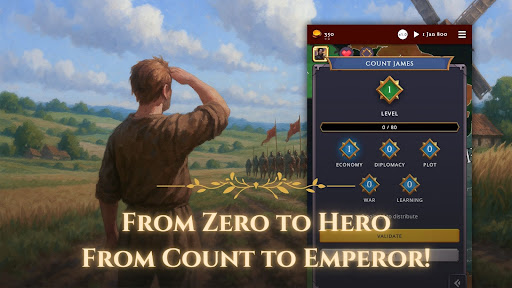
That flexibility is the game's biggest selling point. The description explicitly says you can play as a warmongering king, choose a peaceful scenario, spend time developing cities and building your castle, try the "Zero to Hero" scenario, earn experience points to improve attributes, or play a female leader, historical or not. This is a smart mobile approach to grand strategy because it gives players a reason to replay without asking them to memorize a massive interface on day one. One run can be conquest-heavy, another can focus on dynasty and development, and another can be a role-play challenge built around a custom ruler.
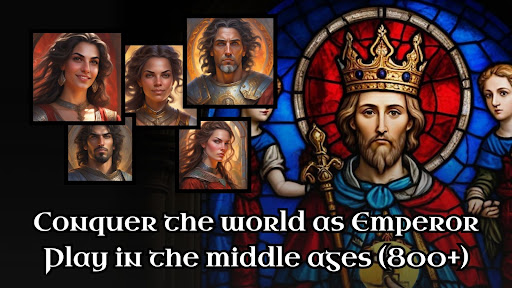
The historical range also helps define the game. The years 800 to 1095 cover the Carolingian world, Viking pressure, medieval consolidation, and a shifting Europe before the later high-medieval period. The listing says the game is based on extensive historical research and includes real geopolitical situations, characters, and organizations, while also admitting that "fun > realism" guides its liberties. That is a healthy promise. A mobile strategy game needs historical flavor and credible situations, but it also needs readable decisions. Charlemagne seems aimed at players who want to feel history pushing back without demanding a textbook-perfect simulation.
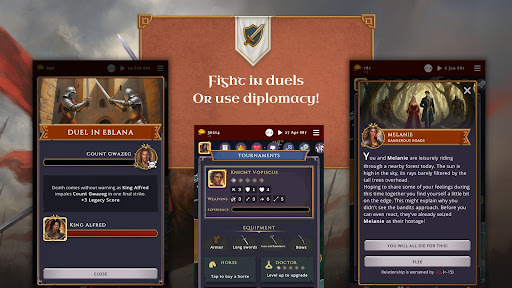
The tactical and strategic systems sound deliberately varied. The store description mentions deep tactical war gameplay, narrative events, tournaments, expeditions, and city-building. Those features should create different tempos. War gives urgency and risk. Events give personality and surprise. Tournaments and expeditions can break up map management with shorter goals. City-building and castle work provide long-term development. If the balance is good, Charlemagne should avoid the common grand strategy problem where every minute becomes either map painting or menu maintenance.
Compared with many free mobile strategy games, Charlemagne's monetization pitch is unusually direct. It says there are no ads and that it is not pay-to-win "because there's not even something to win." Diamonds can be purchased to unlock legendary characters, but the description says diamonds are also granted through gameplay. Optional DLCs such as God Mode and the Royal Hunt can also be unlocked, and once unlocked they work across saves and devices. The local metadata lists IAP from $1.99 to $9.99 per item, which is much lower than the upper ranges common in competitive SLG titles. For players tired of server-rank pressure, this is a major point in its favor.
The trade-off is scale and polish uncertainty. The local metadata shows 5,000+ installs, 99 ratings, and a 4.230769 average. That is a respectable rating, but the audience is still small compared with mainstream strategy games. A niche project can be more inventive and more personal, yet it may also have rougher edges, lighter documentation, or fewer community resources. Anyone expecting a massive production with cinematic battles may need to adjust expectations. Charlemagne's appeal is likely in systems, options, and historical role-play rather than spectacle.
The best comparison is not a base-raiding game. Charlemagne is better understood as a mobile cousin to dynastic grand strategy: smaller, more direct, and more flexible, but interested in similar questions of ruler identity, realm management, war, and succession. Compared with a 4X empire builder, it appears more character-driven. Compared with a pure life sim, it has more war, economics, and geopolitical structure. Compared with a premium PC grand strategy title, it will likely be lighter, but also easier to sample on Android because the base game is free.
Charlemagne is best for players who enjoy making their own story inside a historical sandbox. If you want to conquer Europe as Charlemagne, raid as Vikings, guide a peaceful city-building scenario, or role-play a nonstandard leader, the listing suggests real support for that. If you mainly want competitive multiplayer, flashy real-time combat, or constant rewards, this may feel quiet. Its strengths are agency, historical period focus, no ads, restrained IAP, and a rare mix of grand strategy with personal ruler simulation. Its possible weaknesses are niche presentation, small community size, and the inherent complexity of trying to combine war, dynasty, economy, and narrative in a mobile format.
Overall, Charlemagne Medieval Strategy looks like one of the more thoughtful Android strategy options in this group. It is not selling one endless ladder; it is selling a medieval reign. That distinction makes it especially attractive to patient players who prefer decisions with role-play meaning over louder, faster conquest loops.